


Malcolm Guite’s Arthuriad is making a bit of a splash. The first two books, Galahad and the Grail and The Coming of Arthur, published in America by Rabbit Room Press, have become small-scale phenomenons, with the first volume reaching Amazon’s Top 50 list and both volumes combined already selling more than 100,000 copies (and counting!). Here’s an excellent review in First Things.
I couldn’t be happier. As a long-time reader of Guite, and someone who shares his affection for pipe and pint (as well as poetry), I’m thrilled to see the poet-priest claim the moment in the spotlight that he’s long deserved.
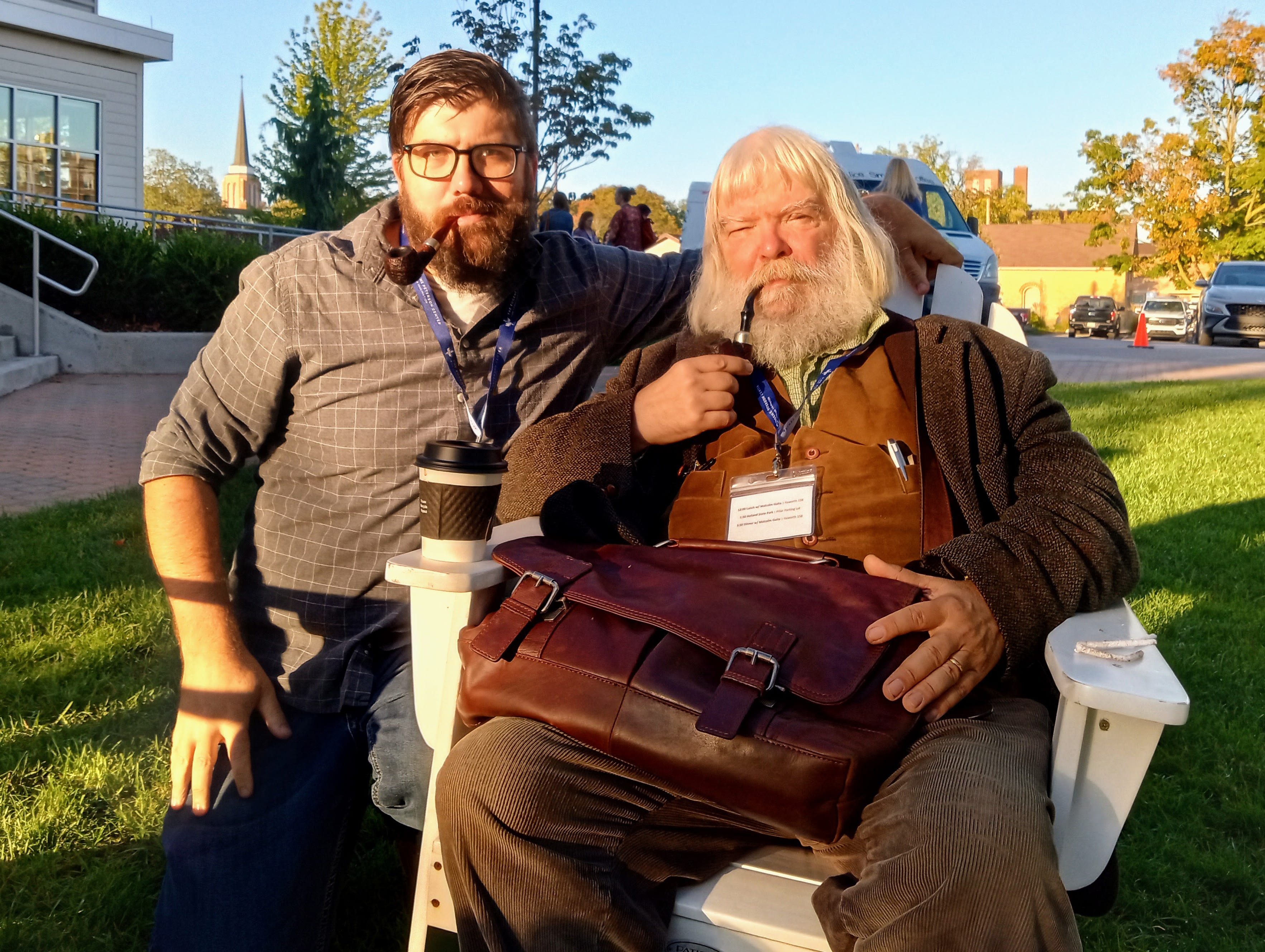
I’ve been reading Guite’s poetry for many years, now, and I read through his collections of sonnets and other poetry long before his Arthuriad came out. Like so many others, I’ve been charmed by his — well, to be frank, by his almost otherworldly, Cantabrigian charm, his hobbity dress and demeanor, and his sonorous way of reading and reciting poetry, but also, of course by the beauty and profundity of his metered verse.
If you’ve recently stumbled across Malcolm Guite and don’t quite know where to go next, I’ve put together a few recommendations. To be clear, I’m not recommending other Arthurian works — instead, all of the poets listed below are Christians whose faith has deeply influenced their formal, metered poetry. And all of them are living poets; you won’t find George Herbert or Gerard Manley Hopkins listed below, excellent as they are. I’m sure there are other contemporary Christian poets worth including, but these are the ones that I’ve read (and continue reading) and that I’m most familiar with.
Malcolm Guite
Okay, so this isn’t quite fair — but if all you know of Guite is Galahad and the Grail and The Coming of Arthur, you really should get a hold of his other, shorter poetry. He’s published several book-length collections of his own poems, as well as some edited compilations of poetry by others.
Psalm 132: CXXXII Memento, Domine
by Malcolm Guite
The perfect love that casts out every fear,
Came down with the Christ, the true annointed one,
Whose coming David saw when Yahweh swore
One of his line, Messiah, David’s son
Would sit upon his throne and wear his crown.
But David died before the deed was done,
Nor did he ever know the promised crown
Would be a crown of thorns, the ‘resting place‘
Would be the sepulchre. God would come down
And earth would meet with heaven face to face,
And when Christ ‘satisfied the poor with bread’
That bread would be his body. In our place
He would face death and suffer in our stead
To set us right. And now the crown of thorns
Is bright with blossom round his sacred head.
Start Here

Pick up David’s Crown: Sounding the Psalms, a collection of 150 poems (one for each psalm) that form a corona, in which the last line of one poem is the first line of the next poem. Buy it from The Rabbit Room or Amazon.
Bonus: Guite’s Lifting the Veil: Imagination and the Kingdom of God (Rabbit Room or Amazon) is the best articulation and defense of the Christian imagination I’ve ever read. And you can listen to Guite read selections of his poetry (set to music by Phil Keaggy) on vinyl or CD.
Daniel Mitsui
There’s something about Daniel Mitsui’s poetry that strikes me as positively Medieval in the very best way. It’s blunt, bold, rhythmic, and unapologetically Christian. And, to my great delight, his poetry is filled with words I don’t understand, whether because they’ve long since passed from common usage, because they’re of his own unique coinage, or because they’re in Latin or other language (see “tatterdemalions” and “acracadabrists” in the excerpt below). Never fear: He includes a glossary in the back of the book.
Mitsui’s collections of original carols, ballads, folk songs and hymns are an excellent complement to the English ballad form and Medieval setting of Guite’s Arthuriad — if that was your first introduction to Guite, I’d highly recommend that you read Mitsui.
an excerpt from “Come to the Feast (A Song for the Downtrodden)”
by Daniel Mitsui
Tatterdemalions, mendicants, aliens,
Vagabonds, wanderers, come to the feast!
Come from the edges of highways and hedges:
The last shall be first and the first shall have least.
Lepers, come ringing your handbells and singing;
Lead all who are stricken with cankers and hurts.
Madmen bedevilled, unclothed and dishevelled,
Come now to the hall to receive your deserts.
Drunkards and sinners, demanders for glimmer,
Ye pickpockets, abracadabrists, and cheats;
Squanderers, harlots in raiment of scarlet,
Be penitent somewhat and everyone eats!
[ … ]
Start Here

Buy it signed from the author here or on Amazon.
Anthony Esolen
Anthony Esolen is a professor, writer, translator, and cultural commentator. He’s perhaps best known for his translation of Dante’s Divine Comedy (pick up his Inferno from Amazon), but he’s also the poet behind The Hundredfold: Songs for the Lord, which the publisher describes as:
“a tapestry of hymns, monologues, and short lyrics knit together as one book-length poem in praise of Christ in all his startling humanity” that draws from “the riches of the English poetic tradition — meter, rhyme, music… ”
Esolen wrote in his introduction that The Hundredfold is “a first salvo in the Christian reclamation of the land of imagination and song,” insisting that “I want not emulators and imitators but people who will charge past me in blood and triumph.“
2 O Lord, our Lord, how wonderful is Thy name in all the earth!
by Anthony Esolen
I love Thy works, O Lord, and always shall:
The fresh sun shining forth in brash delight,
Then blushing gently in his evening fall
Like a youth from a dance; the deeps of night
Swaying the pilgrim spirit to behold
A sea powdered with stars; all life and light
Sprung from the Ancient One who is not old,
Given to man the child. So from above
Glimmers a world of glory manifold,
And my return is gratitude and love.
Start Here

You can find links to buy The Hundredfold at Anthony Esolen’s website.
Philip Rosenbaum
If you thought Guite’s epic poem was lengthy, get a load of Philip Rosenbaum’s The Wedding Feast. I’m only partway through my first reading, and it’s a stunning achievement. The massive book (500 pages of poetry, plus notes!) is a series of 144 poems in Spencerian stanzas, each one told in the voice of a character from the Bible. It’s a remarkable (and audacious) conceit: The speaker is swept into heaven, where he sees the biblical saints preparing for the Wedding Feast of the Lamb. As they’re getting things ready, the Bridegroom poses a riddle: “Why do I choose this Woman as My bride?” Each of the characters takes turns answering the riddle.
an excerpt from “The Song of Rebekah”
by Philip Rosenbaum
[ … ]
Can blessing come to a divided house?
We were so far apart we could not stand.
I did not trust the Lord or my own spouse
Enough to wait and see what God had planned,
So what I built, I built upon the sand.
The consequence was I was left alone
With the very ones I wanted to disband:
Esau could hardly use a civil tone;
Isaac and I could see how far apart we’d grown.
Oh, I was strong enough to have endured
Living with men who hated what I’d done,
That is, if only I had been assured
That it was well with Jacob. (He was the one
I doted on, and only he was gone!)
My guilt contributed to my unease,
Also the sense that I had sent my son
Straight to the house of one whose expertise
Was unsurpassed in sleight of hand and trickeries.
But Jacob will tell you all about that.
The thing I really need to get across,
The target I am always aiming at,
The message I desire to emboss
To save my daughters from the kind of loss
By which our little family was wrecked,
Is, While the Lord is purging out your dross,
Let your poor husband have your true respect,
Though he fails to do what you rightfully expect.
[ … ]
Start Here
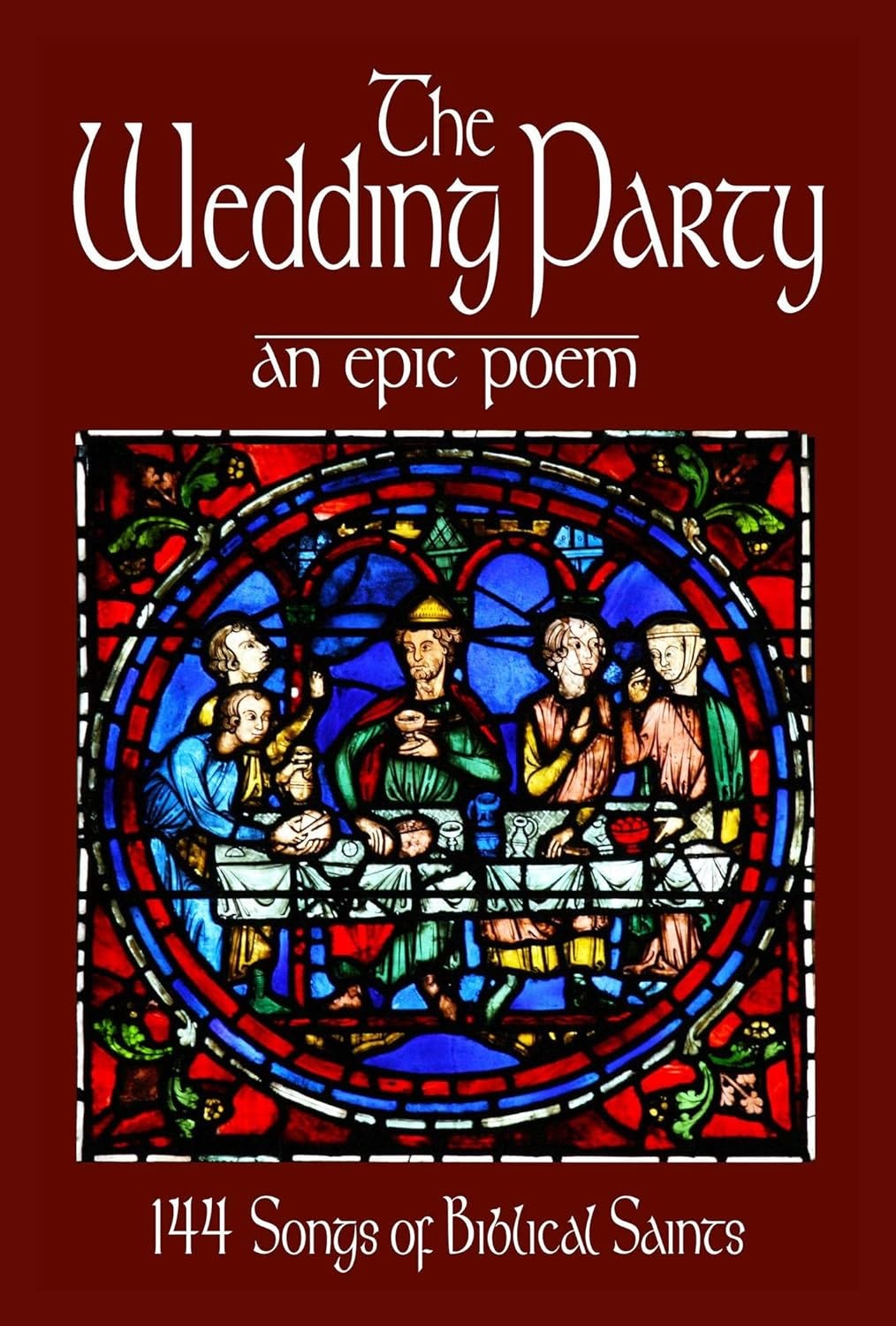
I had to order this book by emailing the author directly at pbrpoet [at] rcn.com (I found his email at the end of this review from the Orthodox Arts Journal). Or you can get a Kindle version from Amazon. Rosenbaum also has a beautiful clothbound hardcover, Holy Week Sonnets, which I haven’t read yet, on account of waiting for Holy Week.
James Matthew Wilson
What I like most about James Matthew Wilson’s poetry is the comfortable way that big themes sit alongside commonplace, pedestrian, contemporary images. Wilson, who directs the MFA program in creative writing at the University of St. Thomas, is thoroughly Christian (and specifically Catholic), and that certainly comes through in his poetry — but it’s less typically devotional than Guite’s poetry is. Still, it’s a delight to read.
For Martha
by James Matthew Wilson
Busy with many things, I know you are,
And watch you turn away and close the door.
I see it in the way you drive your car,
In how things clutter on your kitchen floor.
Someone will advertise new ways to mend it,
To find a method and a discipline,
But you and they both know you’ll never end it,
Just fall for schemes to get rich or grow thin.
Even so, beneath the stirrings of your heart,
There lies some memory of peace and stillness,
An image uncontrived by human art
That makes this life seem one persistent illness.
Turn inward then, just as those teachers say,
Who make of silence words by which to pray.
Start Here

Buy St. Thomas and the Forbidden Birds from the Word on Fire bookstore or from Amazon.
David Middleton
David Middleton sits firmly in the Southern Agrarian tradition, and many of his poems are intimately tied to place (in his case, Louisiana). He’s also deeply influenced by the subjects and meter of classicism, which gives his poems a density and depth that I don’t often encounter. Many of his sentences enjamb over many, many lines (and sometimes even over multiple stanzas), giving one a feeling that one is running breathlessly downhill while reading them. The text below, “Ordinations,” for example, is two long sentences, one for each stanza.
Ordinations
by David Middleton
priest, poet
Receive this Bible as a sign ...
The Book of Common Prayer (1979), 534
Younger than I by nearly forty years,
He stands for examination, then kneels,
The bishop laying hands upon the head
Of one who prays for strength to rise again,
Holding on tight to a Bible, the gift
A bishop gives to all whom God has called
To preach the Word and offer bread and wine.
Here in the pews, near three score years and ten,
I see myself—and not—in that young man,
For I was also called, ordained, my gift
Not given by a bishop but a voice
That left me with the silence of the page
And language from a common lexicon,
The Holy Spirit blessing grape and grain.
Start Here

My introduction to Middleton’s poetry was The Fiddler of Driskill Hill, and that’s as good a place as any to start. Buy it from the publisher or from Amazon. But if you want to go all-in, grab his collected poems: Time Will Tell.
There you have it: My recommendations for living Christian poets who are writing excellent, formal poetry. Who would you add to the list? Let me know in the comments.


Check out my other Substack publications:


If you’d like express your gratitude and contribute to my work, you can buy me a coffee on Ko-fi.
©2026 Josh Bishop, joshbishopwrites.com