


There’s really nothing more to this post — and nothing that connects the two ideas, bicycle and cheese — aside from than the fact that the writing here displays what it looks like to see and appreciate and dwell on the simple pleasures that come from the simple things of life.
“I do not think there is anyone who takes quite such a fierce pleasure in things being themselves as I do. The startling wetness of water excites and intoxicates me: the fieriness of fire, the steeliness of steel, the unutterable muddiness of mud.”
—G.K. Chesterton
Lord, help me to be more like this.
C.S. Lewis on Bicycles

To be fair, this is actually C.S. Lewis relaying what his friend said about bicycles in one of their conversations. Still, Lewis wrote the words down, and they’re worth reading.
“Talking about bicycles,” said my friend, “I have been through the four ages. I can remember a time in early childhood when a bicycle meant nothing to me: it was just part of the huge meaningless background of grown-up gadgets against which life went on. Then came a time when to have a bicycle, and to have learned to ride it, and to be at last spinning along on one’s own, early in the morning, under trees, in and out of the shadows, was like entering Paradise. That apparently effortless and frictionless gliding — more like swimming than any other motion, but really most like the discovery of a fifth element — that seemed to have solved the secret of life. Now one would begin to be happy. But, of course, I soon reached the third period. Pedaling to and fro from school (it was one of those journeys that feel up-hill both ways) in all weathers, soon revealed the prose of cycling. The bicycle, itself, became to me what his oar is to a galley slave.”
“But what was the fourth age?” I asked.
“I am in it now, or rather I am frequently in it. I have had to go back to cycling lately now that there’s no car. And the jobs I use it for are often dull enough. But again and again the mere fact of riding brings back a delicious whiff of memory. I recover the feelings of the second age. What’s more, I see how true they were — how philosophical, even. For it really is a remarkably pleasant motion.”
G.K. Chesterton on Cheese
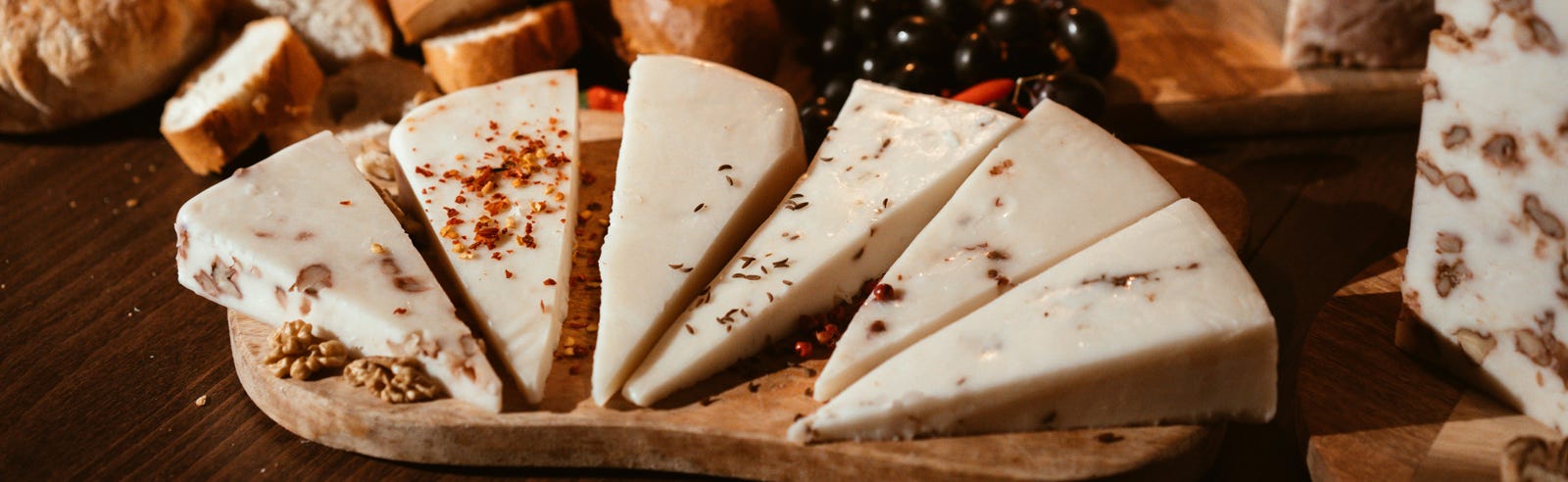
Here’s G.K. Chesterton, in a longer passage from which comes his often-quoted quip, “Poets have been mysteriously silent on the subject of cheese.”
My forthcoming work in five volumes, `The Neglect of Cheese in European Literature,’ is a work of such unprecedented and laborious detail that it is doubtful whether I shall live to finish it. Some overflowings from such a fountain of information may therefore be permitted to springle these pages. I cannot yet wholly explain the neglect to which I refer. Poets have been mysteriously silent on the subject of cheese. Virgil, if I remember right, refers to it several times, but with too much Roman restraint. He does not let himself go on cheese. The only other poet that I can think of just now who seems to have had some sensibility on the point was the nameless author of the nursery rhyme which says: ‘If all the trees were bread and cheese’ — which is indeed a rich and gigantic vision of the higher gluttony. If all the trees were bread and cheese there would be considerable deforestation in any part of England where I was living. Wild and wide woodlands would reel and fade before me as rapidly as they ran after Orpheus. Except Virgil and this anonymous rhymer, I can recall no verse about cheese. Yet it has every quality which we require in an exalted poetry. It is a short, strong word; it rhymes to ‘breeze’ and ‘seas’ (an essential point); that it is emphatic in sound is admitted even by the civilization of the modern cities. For their citizens, with no apparent intention except emphasis, will often say ‘Cheese it!’ or even ‘Quite the cheese.’ The substance itself is imaginative. It is ancient — sometimes in the individual case, always in the type and custom. It is simple, being directly derived from milk, which is one of the ancestral drinks, not lightly to be corrupted with soda-water. You know, I hope (though I myself have only just thought of it), that the four rivers of Eden were milk, water, wine, and ale. Aerated waters only appeared after the Fall.
But cheese has another quality, which is also the very soul of song. Once in endeavouring to lecture in several places at once, I made an eccentric journey across England, a journey of so irregular and even illogical shape that it necessitated my having lunch on four successive days in four roadside inns in four different counties. In each inn they had nothing but bread and cheese; nor can I imagine why a man should want more than bread and cheese, if he can get enough of it. In each inn the cheese was good; and in each inn it was different. There was a noble Wensleydale cheese in Yorkshire, a Cheshire cheese in Cheshire, and so on. Now, it is just here that true poetic civilization differs from that paltry and mechanical civilization that holds us all in bondage. Bad customs are universal and rigid, like modern militarism. Good customs are universal and varied, like native chivalry and self-defence. Both the good and the bad civilization cover us as with a canopy, and protect us from all that is outside. But a good civilization spreads over us freely like a tree, varying and yielding because it is alive. A bad civilization stands up and sticks out above us like an umbrella — artificial, mathematical in shape; not merely universal, but uniform. So it is with the contrast between the substances that vary and the substances that are the same wherever they penetrate. By a wise doom of heaven men were commanded to eat cheese, but not the same cheese. Being really universal it varies from valley to valley. But if, let us say, we compare cheese to soap (that vastly inferior substance), we shall see that soap tends more and more to be merely Smith’s Soap or Brown’s Soap, sent automatically all over the world. If the Red Indians have soap it is Smith’s Soap. If the Grand Lama has soap it is Brown’s Soap. There is nothing subtly and strangely Buddhist, nothing tenderly Tibetan, about his soap. I fancy the Grand Lama does not eat cheese (he is not worthy), but if he does it is probably a local cheese, having some real relation to his life and outlook. Safety matches, tinned foods, patent medicines are sent all over the world; but they are not produced all over the world. Therefore there is in them a mere dead identity, never that soft play of variation which exists in things produced everywhere out of the soil, in the milk of the kine, or the fruits of the orchard. You can get a whisky and soda at every outpost of the Empire: that is why so many Empire builders go mad. But you are not tasting or touching any environment, as in the cider of Devonshire or the grapes of the Rhine. You are not approaching Nature in one of her myriad tints of mood, as in the holy act of eating cheese.
When I had done my pilgrimage in the four wayside public-houses I reached one of the great northern cities, and there I proceeded, with great rapidity and complete inconsistency, to a large and elaborate restaurant, where I knew I could get a great many things besides bread and cheese. I could get that also, however; or at least I expected to get it; but I was sharply reminded that I had entered Babylon, and left England behind. The waiter brought me cheese, indeed, but cheese cut up into contemptibly small pieces; and it is the awful fact that instead of Christian bread, he brought me biscuits. Biscuits—to one who had eaten the cheese of four great countrysides! Biscuits—to one who had proved anew for himself the sanctity of the ancient wedding between cheese and bread! I addressed the waiter in warm and moving terms. I asked him who he was that he should put asunder those whom Humanity had joined. I asked him if he did not feel, as an artist, that a solid but yielding substance like cheese went naturally with a solid, yielding substance like bread; to eat it off biscuits is like eating it off slates. I asked him if, when he said his prayers, he was so supercilious as to pray for his daily biscuits. He gave me generally to understand that he was only obeying a custom of Modern Society. I have therefore resolved to raise my voice, not against the waiter, but against Modern Society, for this huge and unparalleled modern wrong.”
Okay, one more on cheese
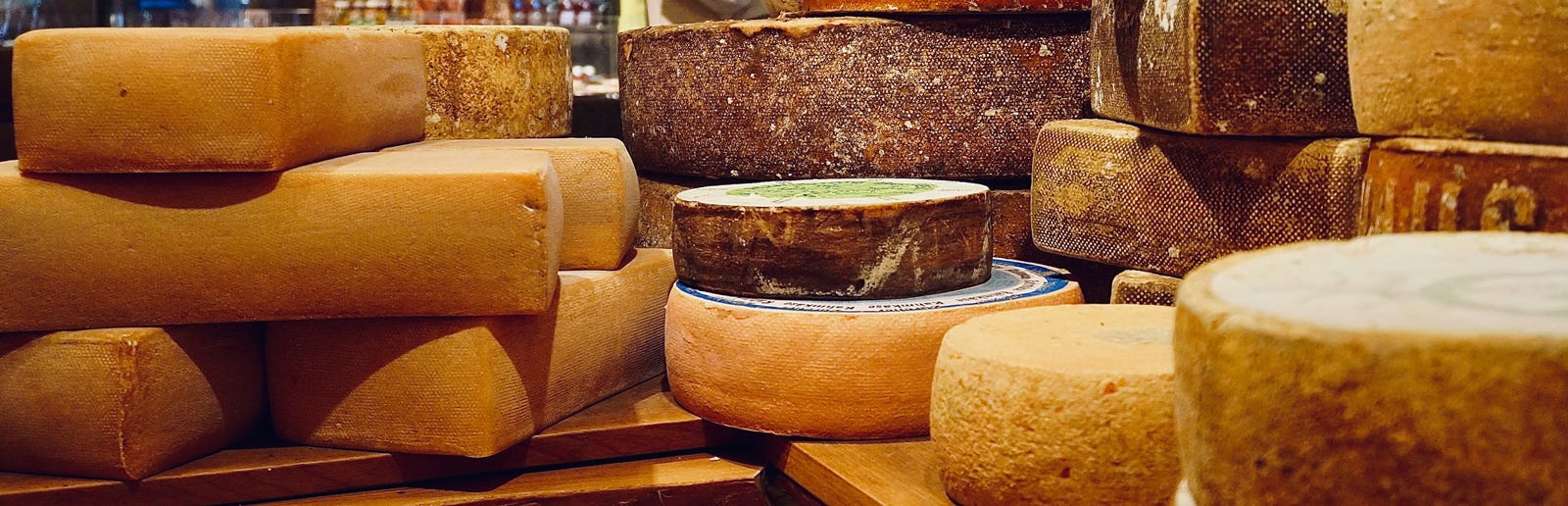
Chesterton’s piece puts me in mind, of another cheese-y quote, one of my all-time favorites — this one from Rod Dreher, who takes a sacramental approach:
Some people wrongly make an idol of food, or of art, or of sport, or such things. This we must avoid, but we also must avoid the opposite thing, which is to denigrate the body and the material world by assuming that all pleasure derived from the enjoyment of creation is illicit, or at least suspect. When I taste a good cheese, for example, it makes me not only happy, but joyful. The happiness comes from this thought: “How delicious this is!” The joy comes from this thought: “How wonderful to live in a world where such happiness can come from such simple things!” For Christians who see the world through a sacramental lens, the divine expresses itself in part through matter. For those with eyes to see, the cheeses in the picture are radiant with the glory of God. For me, when I taste something extraordinarily good, my first impulse is to say a prayer of thanksgiving. I know not everyone is like this, but for me, moments like this are theophanies — a sudden disclosure of God’s presence in the world, and a reminder that however much boredom and pain we have to bear, God is still present with us, and will disclose Himself in His creation, if we are open to it, and grateful for it.


Check out my other Substack publications:


Josh Bishop Writes is sponsored by New Saint Anne’s.

Thanks for sharing these, the Chesterton quote was phenomenal. I laughed out loud in a few sections!
In college we were a part of a cheese club that often read the Chesteron piece before a cheese gala in which every part of a four course meal was cheese!